Next: Energy Balance: Egg Production
Previous: Energy Balance: Movement
Energy Balance: Molting
Molting requires that a crab expend a great deal of energy generating
a new exoskeleton - peak energy expenditure occurs immediately after
shedding (deFur 1990) at a rate comparable in magnitude to that
of exercising crabs in high salinity water (Booth and McMahon 1992).
Shedding of the old exoskeleton for 10.1 to 12.7 cm CW crabs is done
within two to three hours (van Engle 1958); it takes
approximately 9-12 hours for the shell to acquire a papery or leathery
texture; and another 12-24 hours for the shell to fully
harden (van Engle 1958; Freeman et al. 1987). During molting, CW
increases on average by 15 to 35% over temperatures between
14 to 32 C and salinity of 7.5 to 26
psu (Tagatz 1968). Crabs molt more frequently at higher
temperatures (leading to greater daily rates of CW increase) but the
percentage increase in CW per molt is
smaller (Leffler 1972). Crabs 1.3 to 2.5 cm CW molt every 10 to
15 days, while
to 32 C and salinity of 7.5 to 26
psu (Tagatz 1968). Crabs molt more frequently at higher
temperatures (leading to greater daily rates of CW increase) but the
percentage increase in CW per molt is
smaller (Leffler 1972). Crabs 1.3 to 2.5 cm CW molt every 10 to
15 days, while  cm CW crabs molt every 20 to 50
days (Ryer et al. 1990; van Engle 1958). Molting does not occur
during November through April. The average CW of sexually mature
female crabs ranges between 7.5 and 20 cm with a mean of 14.4
cm (Fisher 1999) or
cm CW crabs molt every 20 to 50
days (Ryer et al. 1990; van Engle 1958). Molting does not occur
during November through April. The average CW of sexually mature
female crabs ranges between 7.5 and 20 cm with a mean of 14.4
cm (Fisher 1999) or  200 g and males are larger than
females (e.g., Olmi III and Bishop 1983).
200 g and males are larger than
females (e.g., Olmi III and Bishop 1983).
In the model, molting is triggered when a crab's mass,  , becomes
greater than the mass when molting is triggered causing
molt flag to be set to preparing to molt. The
duration of molting depends on the amount of energy (g) that the crab
must expend to molt and the rate at which it can expend this energy.
When molting starts, the crab cannot eat (eating status =
not eating) nor does it move. The total energy a crab must
expend to molt depends on its size:
, becomes
greater than the mass when molting is triggered causing
molt flag to be set to preparing to molt. The
duration of molting depends on the amount of energy (g) that the crab
must expend to molt and the rate at which it can expend this energy.
When molting starts, the crab cannot eat (eating status =
not eating) nor does it move. The total energy a crab must
expend to molt depends on its size:
Gtotal to molt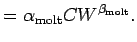 |
(A.49) |
For
 g/cm
g/cm
 with
with
 , a 15 cm CW crab will use
 g to
molt.
g to
molt.
The rate at which the crab molts depends on the crab's metabolic rate
which governs the rate of mass use due to energy expenditure during
molting,
 molt (g/hr):
Gmolt |
(A.50) |
 max met=0.00678 (hr
 .g
.g
 ) (Booth and McMahon 1992, Table 1) and
(Houlihan et al. 1985, Fig 1). Based on the equation, larger crabs
expend energy at a faster rate.
total to molt is given by
Eqn (A.46),
total molted is the number or
grams of energy that the crab has already expended molting,
) (Booth and McMahon 1992, Table 1) and
(Houlihan et al. 1985, Fig 1). Based on the equation, larger crabs
expend energy at a faster rate.
total to molt is given by
Eqn (A.46),
total molted is the number or
grams of energy that the crab has already expended molting,
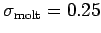 governs the rate of mass use from energy
expenditure as molting progresses.
governs the rate of mass use from energy
expenditure as molting progresses.
 Temp is the same as the
term in Eqn (A.44) and accounts for a crab's
metabolic rate at different temperatures.
molt is shown in
Fig. A11 at a temperature of
Temp is the same as the
term in Eqn (A.44) and accounts for a crab's
metabolic rate at different temperatures.
molt is shown in
Fig. A11 at a temperature of
 opt met
 as a function of CW and
 . A crab with a 15
cm CW will take
. A crab with a 15
cm CW will take
 days to fully molt.
As a crab molts,
total molted is incremented and the crab
stops molting when
total molted total to molt.
The molt flag is then set to not molting and the
crab's state variables are updated, including the crab's
current CW, mass next molt triggered, mating
status and stomach volume.
total to molt.
The molt flag is then set to not molting and the
crab's state variables are updated, including the crab's
current CW, mass next molt triggered, mating
status and stomach volume.
The proportion increase of the crab's CW at molting depends on the
temperature of the crab's environment and is based on model proposed
by Smith (1997). The further the temperature is away from the
crab's optimal metabolic temperature,
opt met, the smaller
the average percent increase. The proportion increase in CW ranges
from
 to
to
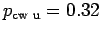 . The actual
proportion increase is generated randomly. Let
. The actual
proportion increase is generated randomly. Let  be a realization
of a uniform RV on
be a realization
of a uniform RV on ![$ [0, 1]$](img160.png) ,
,
 |
(A.51) |
and
 . Let
. Let
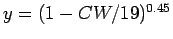 if CW
if CW  19 cm
and 0 otherwise.
19 cm
and 0 otherwise.  is used to decrease the changes in CW per molt
as the crab's CW gets closer to 19 cm. The random increase in
CW is given by:
is used to decrease the changes in CW per molt
as the crab's CW gets closer to 19 cm. The random increase in
CW is given by:
 |
(A.52) |
where
 cw,l is the lower proportion of CW increase and
cw,u is the upper proportion increase.
cw,l is the lower proportion of CW increase and
cw,u is the upper proportion increase.
The new mass when molting triggered is given by applying
Eqn (A.36) to
 (Eqn A.49) and the crab's new stomach volume is given by Eqn (A.37). In the model, male crabs
cease molting once they reach the 20th instar. If a crab is female
and is reaching its 18th molt, it mates with a male provided a male
with an instar greater than 18 is present within 5 times the
maximum interaction distance (See
Appendix A.5.3). If the female mates, its
mating status is set to mated. If a suitable male
is not present, the female will not mate, but will attempt to mate
again the next time she molts. Following molting, the crab's
eating status is set to foraging and the crab is
able to move again.
(Eqn A.49) and the crab's new stomach volume is given by Eqn (A.37). In the model, male crabs
cease molting once they reach the 20th instar. If a crab is female
and is reaching its 18th molt, it mates with a male provided a male
with an instar greater than 18 is present within 5 times the
maximum interaction distance (See
Appendix A.5.3). If the female mates, its
mating status is set to mated. If a suitable male
is not present, the female will not mate, but will attempt to mate
again the next time she molts. Following molting, the crab's
eating status is set to foraging and the crab is
able to move again.
Next: Energy Balance: Egg Production
Previous: Energy Balance: Movement