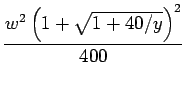
95% full,
eating status is changed from eating to
foraging, meaning the crab can move around the estuary.
95% full,
eating status is changed from eating to
foraging, meaning the crab can move around the estuary.
The above feeding algorithm gives the number of grams of food the crab found since it was last updated. However, the mass of food feeding on is not the same as the amount of food ingested into a crab's stomach. One reason for this distinction is if the crab is feeding on another crab it may not ingest an entire crab before it is satiated and moves on.
A crab continues to feed until either its stomach becomes full or it
consumes all the mass of food feeding on. In the first case,
eating status is set to not eating, mass of
food feeding on is set to zero and any remaining food is returned to
the estuary as part of the lower quality background prey on that
triangle. In the second case, if the stomach is 95% full,
eating status is changed from eating to
foraging, meaning the crab can move around the estuary.
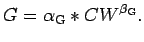
Computing the mass of food ingested requires models of a crab's
stomach size and ingestion rate. The allometric relationship used
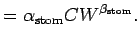
between a crab's CW and mass,  ,
is (Pullen and Trent 1970; Olmi III and Bishop 1983; Cadman and Weinstein 1985; Newcombe et al. 1949):
,
is (Pullen and Trent 1970; Olmi III and Bishop 1983; Cadman and Weinstein 1985; Newcombe et al. 1949):
 is 2.7 and
 is 0.14 g/cm
 .
A crab's stomach volume,
.
A crab's stomach volume,
 (cm
(cm ), is given by:
 -0.55 (Wallace 1973). If
the wet weight of the crab is given by Eqn (A.36) and
is 2.7, this suggests that
-0.55 (Wallace 1973). If
the wet weight of the crab is given by Eqn (A.36) and
is 2.7, this suggests that
 is
is
 .
.
 is set at 0.0265 (cm).
The volume of food in a crab's stomach is given by
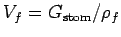 (cm) where the density of the food,
 (g/cm), is assumed constant for all food types. The
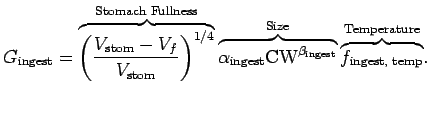
rate at which food is ingested into the stomach from the mass
of food feeding on depends on stomach fullness, crab size and
temperature:
(g/cm), is assumed constant for all food types. The
rate at which food is ingested into the stomach from the mass
of food feeding on depends on stomach fullness, crab size and
temperature:
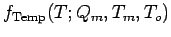
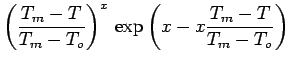
 is based on a
model proposed for yellow perch (Kitchell and Stewart 1977):
is based on a
model proposed for yellow perch (Kitchell and Stewart 1977):
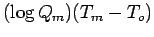
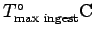 is the maximum temperature at which crabs
feed while
is the maximum temperature at which crabs
feed while
 is the temperature giving maximum
feeding rate (Eqn A.39,
Fig. A7). At
is the temperature giving maximum
feeding rate (Eqn A.39,
Fig. A7). At
 , crabs with a CW of 15 cm
(an empty stomach volume of
, crabs with a CW of 15 cm
(an empty stomach volume of  cm) require approximately
15 minutes to fill their stomachs.
cm) require approximately
15 minutes to fill their stomachs.
 stom
stom