Next: Scaling of the Estuary
Previous: Rules: Larval Development and
Rules: Sources of Mortality
Mean annual natural mortality rate is  0.375
(Eggleston 1998; Rugolo et al. 1998) and only about one out of every
million eggs survives to become an
adult (van Engle 1958). Although crabs can live as long as 8
years, the average age in the Chesapeake population is 1.5
yrs and
0.375
(Eggleston 1998; Rugolo et al. 1998) and only about one out of every
million eggs survives to become an
adult (van Engle 1958). Although crabs can live as long as 8
years, the average age in the Chesapeake population is 1.5
yrs and
 % of all individuals are less than 3 yrs of
age (Rugolo et al. 1998).
% of all individuals are less than 3 yrs of
age (Rugolo et al. 1998).
In the model, a crab dies either because of aggression from other
crabs, temperature extremes, starvation, a lack of oxygen, or when it
reaches its life expectancy. Rules governing crab death as a result of
interactions between crabs were discussed in
Appendix A.5.3. If the temperature at the
crab's location goes below 5
 or above 35
(the min and
max temperatures for the crab's metabolic processes
(Tagatz 1969, Table 1)) the crab dies immediately due to thermal
stress. A crab dies of starvation if its mass drops below 40% of its
maximum weight,
or above 35
(the min and
max temperatures for the crab's metabolic processes
(Tagatz 1969, Table 1)) the crab dies immediately due to thermal
stress. A crab dies of starvation if its mass drops below 40% of its
maximum weight,
 . Likewise, a crab dies due to a lack
of oxygen if the DO in the environment encountered by the crab is
continuously below 1 mg/L for more than 3 days. The criteria for
death due to hypoxia are kept simple because in the actual estuary,
crabs will likely swim up to the oxygen rich surface waters if the
bottom waters become hypoxic (Das and Stickle 1994). This condition is
included as a way to ensure that the crab movement algorithm is
sufficient for getting crabs out of hypoxic waters in a timely
fashion. Lastly, crabs may die due to other causes not explicitly
modeled. The life expectancy of crabs (assuming no predation) is
assumed to follow a Beta distribution. The life expectancy of a crab
(assuming the do not die from specific model causes)
is generated when the crab is first instantiated into the estuary
(Appendix A.5.13). Let
. Likewise, a crab dies due to a lack
of oxygen if the DO in the environment encountered by the crab is
continuously below 1 mg/L for more than 3 days. The criteria for
death due to hypoxia are kept simple because in the actual estuary,
crabs will likely swim up to the oxygen rich surface waters if the
bottom waters become hypoxic (Das and Stickle 1994). This condition is
included as a way to ensure that the crab movement algorithm is
sufficient for getting crabs out of hypoxic waters in a timely
fashion. Lastly, crabs may die due to other causes not explicitly
modeled. The life expectancy of crabs (assuming no predation) is
assumed to follow a Beta distribution. The life expectancy of a crab
(assuming the do not die from specific model causes)
is generated when the crab is first instantiated into the estuary
(Appendix A.5.13). Let
 Beta
Beta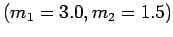 then the time when dies due to
other causes is given by
then the time when dies due to
other causes is given by  . Thus, we assume crabs don't live
beyond 8 years.
. Thus, we assume crabs don't live
beyond 8 years.