 where
where
 and
and
 max spawn.
 maturation
 is a constant chosen so that at a
temperature of
is a constant chosen so that at a
temperature of
 min spawn
 , development to 7th
instar takes 145 days and at
max spawn
, development to 7th
instar takes 145 days and at
max spawn it takes 80
days.
it takes 80
days.
In addition to computing a crab's energy balance, another important component of the model involves development, recruitment and initialization of crabs into the model estuary. Development of spawned crab eggs occurs in the maturation pot object representing the ocean. All eggs released over a single day by all female crabs in the estuary are stored in a single ``egg pot''. The maturation pot is comprised of a sequential, linked list of pots each containing the number of larvae/juvenile crabs and their collective development stage. Once a day, the larvae/young crabs in this list are updated and growth and mortality applied based on the average temperature for that day. Based on the development information for blue crabs (Etherington and Eggleston 2000; van den Avyle 1984; van Engle 1958; O'Leary Amsler and George 1984), it is assumed that crabs take anywhere from 80 to 145 days to go from spawned egg to 7th instar - the stage when the crabs are moved from the egg pots and instantiated into the estuary. Crabs are instantiated at the 7th instar to avoid the computational costs of modeling large numbers of juvenile crabs which have very short lifespans.
It is assumed that the rate at which the crabs progress through
development depends solely on average temperature. The development
rate of larvae/crabs in each egg pot is taken to be linear with
mean temperature, T (Eqn A.4), according to
where
and
max spawn.
maturation is a constant chosen so that at a
temperature of
min spawn, development to 7th
instar takes 145 days and at
max spawn it takes 80
days.
Larvae/crabs in an egg pot die at a constant rate where the proportion
surviving after a time interval  is
is
 mat
mat and
and
 mat
mat (1/hr). Thus, the longer
the development the greater the mortality. Over an 80 d development,
the proportion of the larvae/crabs surviving is
(1/hr). Thus, the longer
the development the greater the mortality. Over an 80 d development,
the proportion of the larvae/crabs surviving is
 while
over 145 d it is only
while
over 145 d it is only
 . If the mean temperature
given by Eqn (A.4) is outside the range
. If the mean temperature
given by Eqn (A.4) is outside the range
 min spawn
 max spawn
![$ ]$](img341.png) , all the larvae/crabs in
the egg pots die.
, all the larvae/crabs in
the egg pots die.
The degree to which megalopae return to a particular estuary is
unknown and dispersal between estuaries is likely. However, the large
distance between major estuaries in the Mid Atlantic Bight and the
coherence between spawning and recruitment events suggests that larvae
often return to their parent estuary (Garvine et al. 1997). North
Atlantic estuaries show constant low levels of daily settlement
punctuated by significant, episodic peaks that can account for  %
of the annual settlement at a site (van Montfrans et al. 1995).
Variables such as wind vectors, radiant energy and surface temperature
are thought to be important predictors of
recruitment (Rugolo et al. 1998; Epifanio 1995; Tang 1985).
%
of the annual settlement at a site (van Montfrans et al. 1995).
Variables such as wind vectors, radiant energy and surface temperature
are thought to be important predictors of
recruitment (Rugolo et al. 1998; Epifanio 1995; Tang 1985).
Thus, the proportion of 7th instar crabs recruited into the model
estuary is generated randomly and is negatively correlated with the
current density of crabs in the estuary and positively correlated with
the number crabs produced by the egg pots. Let  be a
realization of a uniform RV on
be a
realization of a uniform RV on ![$ [0, 1]$](img160.png) and let
and let
 Crab
Density
Crab
Density max ((#/m
 )/(#/m)). The maximum density
of 7th to 20th instar crabs in the estuary is assumed to be no larger
than
)/(#/m)). The maximum density
of 7th to 20th instar crabs in the estuary is assumed to be no larger
than
 max
max (#/m). The proportion of the 7th
instar crabs instantiated from the egg pots for a given day is
(#/m). The proportion of the 7th
instar crabs instantiated from the egg pots for a given day is
 . Thus, if the crab density is less than
max (#/ m) a larger proportion are instantiated
then when the density is greater than
max. This
reflects the fact that the higher the crab density in the estuary, the
smaller the proportion of recruits surviving past the 7th instar.
. Thus, if the crab density is less than
max (#/ m) a larger proportion are instantiated
then when the density is greater than
max. This
reflects the fact that the higher the crab density in the estuary, the
smaller the proportion of recruits surviving past the 7th instar.
Instantiated crabs are randomly placed in the estuary. Let  and
and
 denote realizations from a uniform random variable over
and let
denote realizations from a uniform random variable over
and let  and
and  denote the horizontal and vertical
dimensions of the rectangle containing the part of the estuary being
modeled. Under a wind driven mechanism of recruitment, it is likely
that higher densities of megalopae and juvenile crabs will be found
toward the mouth of the estuary. The initial location of an
instantiated crab is given by
denote the horizontal and vertical
dimensions of the rectangle containing the part of the estuary being
modeled. Under a wind driven mechanism of recruitment, it is likely
that higher densities of megalopae and juvenile crabs will be found
toward the mouth of the estuary. The initial location of an
instantiated crab is given by
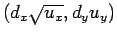 provided
this location is contained in the estuary.
provided
this location is contained in the estuary.
A crab's sex is specified randomly based on a Bernoulli random
variable where the probability of male is dependent on the
sex ratio (assumed to be 50%). Both initial CW and mass contain a
random component. The initial CW of the instantiated 7th instar crab
is uniformly distributed over 1.05 to 1.65 cm while the initial mass
of the crab,
 , is given by applying
Eqn (A.36) to
, is given by applying
Eqn (A.36) to
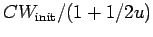 where
is a realization from a uniform random variable over . Thus,
the initial mass of the crab is set below the mass at which molting
would be triggered. The crab's initial stomach volume is given by
Eqn (A.37).
where
is a realization from a uniform random variable over . Thus,
the initial mass of the crab is set below the mass at which molting
would be triggered. The crab's initial stomach volume is given by
Eqn (A.37).