 C (Borsuk et al. 2001b; Selberg et al. 2001). The temperature field
consists of deterministic and random components and is given by:
C (Borsuk et al. 2001b; Selberg et al. 2001). The temperature field
consists of deterministic and random components and is given by:
Bottom water temperatures in the Neuse range between 4 and 32 C (Borsuk et al. 2001b; Selberg et al. 2001). The temperature field
consists of deterministic and random components and is given by:
The first part of the temperature field is deterministic and was
obtained by fitting time-series data of bottom water temperature from
a single location in the Neuse (LT11 near the bend in
Fig. A2). These data were fit to a sinusoidal function
where time,  , is in hours:
The second term in Eqn (A.3) alters
 depending on the depth
  at a given location
 and the season:
 ) warmer
in winter and colder in summer (the reverse for shallower areas) to
reflect estuarine patterns (Fig. A3).
) warmer
in winter and colder in summer (the reverse for shallower areas) to
reflect estuarine patterns (Fig. A3).
The Gaussian random field,  , in Eqn (A.3) is
generated with
, in Eqn (A.3) is
generated with
 ,
,
 , and
, and
 set to 1000 (m), 800 (m) and 48 (hrs) respectively based on the data
presented in Luettich Jr. et al. (1999) and Selberg et al. (2001). The
degree of variation in the final field is assumed to decrease toward
the eastern boundary of the estuary. Let
set to 1000 (m), 800 (m) and 48 (hrs) respectively based on the data
presented in Luettich Jr. et al. (1999) and Selberg et al. (2001). The
degree of variation in the final field is assumed to decrease toward
the eastern boundary of the estuary. Let
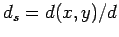 max be the proportional horizontal distance from the
western most boundary of the estuary and
max be the proportional horizontal distance from the
western most boundary of the estuary and
 max (m) the
maximum horizontal length of the estuary. See the online appendices
for movies and Appendix B.2
for further summary of this and the other environment variables.
max (m) the
maximum horizontal length of the estuary. See the online appendices
for movies and Appendix B.2
for further summary of this and the other environment variables.


