 div div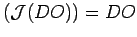 source source sink sink |
(A.8) |
The Neuse is characterized as an intermittently-mixed estuary with wind being the primary mechanism controlling vertical mixing (Borsuk et al. 2001b; Luettich Jr. et al. 1999) temporarily dissipating bottom water hypoxia. Hypoxia is typically defined as dissolved oxygen concentrations (DO) ranging from 0.2 to 2 mg/L with anoxic conditions occurring below 0.2 mg/L. Over an entire year, DO in the Neuse ranges from 0.1 to 10.6 mg/L with hypoxic conditions developing intermittently during summer, lasting from a few days to weeks and varying intra and inter seasonally (Selberg et al. 2001). Empirically, the duration of continuous hypoxia at a given location is about 9 days in the deep parts of the estuary which experience multiple hypoxic episodes throughout the summer. The primary mechanisms causing hypoxia at any location in the estuary is oxygen usage by the biomass and sediments (which is temperature dependent) while the primary mechanisms dissipating hypoxia are oxygen diffusion from the surface waters (which is also a temperature dependent process) and random wind events that mix the oxygen rich surface waters with the oxygen depleted bottom waters.
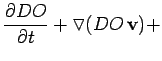
The model for DO (mg/L) results from greatly simplifying a more complex model (Mauersberger 1983) obtained using the principle of mass conservation:
 , and is represented by the second
term on the LHS. The dispersion term,
, and is represented by the second
term on the LHS. The dispersion term,
 (m/hr),
represents the effective diffusion consisting of molecular diffusion,
turbulent ``eddy diffusivity'' and other types of random mixing
processes.
(m/hr),
represents the effective diffusion consisting of molecular diffusion,
turbulent ``eddy diffusivity'' and other types of random mixing
processes.
 source (mg.L
 .hr) represents
sources of oxygen into the system (re-aeration from the
surface and random wind-mixing events) and
sink
(mg.L.hr) sinks due to biological and chemical oxygen
demand.
.hr) represents
sources of oxygen into the system (re-aeration from the
surface and random wind-mixing events) and
sink
(mg.L.hr) sinks due to biological and chemical oxygen
demand.
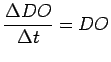
Because the Neuse has a very long residence time (Kim 1990; Luettich Jr. et al. 1999), the advection term,
, is
considered insignificant. Under calm conditions that favor the
formation of hypoxia,
 is dominated by molecular
diffusion which is small (Hyer et al. 1971) and thus will be
considered insignificant. The overall sink term is split into two
components: oxygen demand from sediments and demand from clam and
background biomass. Similarly, the source term is split into a
component dealing with re-aeration from the surface and a second
component,
is dominated by molecular
diffusion which is small (Hyer et al. 1971) and thus will be
considered insignificant. The overall sink term is split into two
components: oxygen demand from sediments and demand from clam and
background biomass. Similarly, the source term is split into a
component dealing with re-aeration from the surface and a second
component,  , dealing with random mixing events (i.e., wind) and is
used to control the shape, duration and extent of hypoxia in the model
estuary. This yields:
, dealing with random mixing events (i.e., wind) and is
used to control the shape, duration and extent of hypoxia in the model
estuary. This yields:
 hours is the update time for all environmental
variables.
source is given by an equation governing
re-aeration from the surface
(mg.L.hr) (Chapra 1997; Schnoor 1996, Sec 6.3):
hours is the update time for all environmental
variables.
source is given by an equation governing
re-aeration from the surface
(mg.L.hr) (Chapra 1997; Schnoor 1996, Sec 6.3):
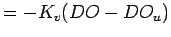
 (mg/L) is the concentration of oxygen in the upper water
column at saturation. This is given by (Hyer et al. 1971, Eqn 12)
(mg/L) is the concentration of oxygen in the upper water
column at saturation. This is given by (Hyer et al. 1971, Eqn 12)
 (Eqn A.3) is the temperature (
 ).
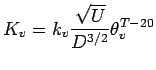
).  (1/hr)
is given by an equation similar to the O'Connor-Dobbins equation (Schnoor 1996, Sec 6.3)
.
(1/hr)
is given by an equation similar to the O'Connor-Dobbins equation (Schnoor 1996, Sec 6.3)
.
 =0.003 (m/hr
 ) is a constant (Borsuk et al. 2001b; Schnoor 1996, Table 6.3),
  is the mean
tidal velocity taken to be 100 m/hr (Luettich Jr. et al. 1999),
is the mean
tidal velocity taken to be 100 m/hr (Luettich Jr. et al. 1999),  (m) is
the depth of the estuary,
(m) is
the depth of the estuary,
 (Borsuk et al. 2001b, Table 1).
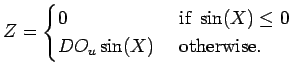
Random mixing events, (mg.L.hr) in
Eqn A.9, are modeled by transforming a Gaussian random
field. The Gaussian field used to generate bottom salinity,  , is
used (Appendix A.3.3), after it is transformed by:
, is
used (Appendix A.3.3), after it is transformed by:
The rate at which oxygen is used depends on the total clam and
background biomass,
 total (g/m
 ) present on a triangle
and the oxygen usage by the sediments. Oxygen utilization by crabs is
ignored since crabs are mobile and crab biomass density per m is
much less than the combined clam and background biomass density. It
is assumed that clam and background biomass can be combined into one
term. The rate of oxygen usage (mg.L.hr) by the biomass
on a triangle is similar to Hummel (1985a):
) present on a triangle
and the oxygen usage by the sediments. Oxygen utilization by crabs is
ignored since crabs are mobile and crab biomass density per m is
much less than the combined clam and background biomass density. It
is assumed that clam and background biomass can be combined into one
term. The rate of oxygen usage (mg.L.hr) by the biomass
on a triangle is similar to Hummel (1985a):
 (1/hr) (Eqn A.17) is the
clam's maximum rate of respiration, 0.167 converts the final rate of
respiration to mg.L.hr, is the average depth of the triangle,
(1/hr) (Eqn A.17) is the
clam's maximum rate of respiration, 0.167 converts the final rate of
respiration to mg.L.hr, is the average depth of the triangle,
 decreases linearly with DO for DO
  4 mg/L
(Eqn A.19) since clams (and it is assumed the background
biomass) decrease their respiration rate under low oxygen conditions, and
4 mg/L
(Eqn A.19) since clams (and it is assumed the background
biomass) decrease their respiration rate under low oxygen conditions, and
 (Eqn A.18) alters the
respiration rate of the biomass with temperature.
(Eqn A.18) alters the
respiration rate of the biomass with temperature.
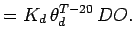
The oxygen used by the sediments (mg.L.hr) on the
triangle is given by:
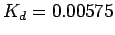 (1/hr) (Borsuk et al. 2001b, Table 1) is the sediment
oxygen demand and
(1/hr) (Borsuk et al. 2001b, Table 1) is the sediment
oxygen demand and
 (Borsuk et al. 2001b, Table 1)
controls how this rate changes with temperature.
(Borsuk et al. 2001b, Table 1)
controls how this rate changes with temperature.
For a triangle at a depth of 5 m, a DO of 4 (mg/L) and temperatures of
20, 25 and 30
sediment oxygen demand is
 , 0.053,
0.078 (mg.L.hr), respectively and if the density of
biomass on the triangle is 800 g/m, its oxygen demand is
, 0.053,
0.078 (mg.L.hr), respectively and if the density of
biomass on the triangle is 800 g/m, its oxygen demand is  0.009, 0.007 and 0.002 (mg.L.hr) respectively, since the
biomass uses less oxygen at higher temperatures. The rate of
re-aeration of the bottom waters depends on depth
(Eqns A.10 and A.12) with deeper waters taking
longer to re-aerate than shallower. Following mixing, deeper waters
take longer to become hypoxic because more oxygen is stored above
them. Finally, in Eqn (A.9), we also add the
constraints that DO
0.009, 0.007 and 0.002 (mg.L.hr) respectively, since the
biomass uses less oxygen at higher temperatures. The rate of
re-aeration of the bottom waters depends on depth
(Eqns A.10 and A.12) with deeper waters taking
longer to re-aerate than shallower. Following mixing, deeper waters
take longer to become hypoxic because more oxygen is stored above
them. Finally, in Eqn (A.9), we also add the
constraints that DO  and DO
  .
.
 source