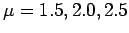
 ), changing the width
of the function by altering
), changing the width
of the function by altering  to 0.4, 0.5, and 0.6 and changing
the overall height of the function by setting
to 0.4, 0.5, and 0.6 and changing
the overall height of the function by setting
 inter to
0.7, 0.8, and 0.9.
inter to
0.7, 0.8, and 0.9.
Shifting the function Left or Right (i.e., changing the ratio of crab sizes at which death due to aggression is most likely) had the largest effect of the two possibilities considered. Shifting Left (crabs 1.5 times smaller experience maximum mortality due to aggression) lead to a higher overall survival than shifting Right (Fig. B16). This counter-intuitive result is caused by differences in the density of 7-12 instar crabs leading to differences in survival, as discussed in the paper. Changing the width or height of the function had little influence on survival, gut fullness or average food quality of 18+ crab densities.