Next: Energy Balance: Ingestion
Previous: Crab Energy Balance: Overview
Energy Balance: Foraging and Finding Clams or Background Prey
Blue crabs are highly omnivorous, feeding on molluscs (both bivalves
and gastropods), fish, small benthic infauna, algae, vascular plants
and conspecifics - depending on prey availability (Eggleston 1990; Laughlin 1982). A summary of previous diet
studies done on the genus Callinectes noted that molluscs
(primarily soft shelled clams) and crustaceans account for between
41% and 71% of a crab's diet, with molluscs accounting for between
21% and 45% (Mantelatto and Christofoletti 2001). Macoma balthica
and Macoma mitchelli - the dominant bivalves in the Neuse
estuary - thus form the dominant component of a crab's
diet (Sullivan and Gaskill 1998). Crabs, clams and the background prey
have different caloric contents: crabs 1000 cal/g wet (Cummins and Wuycheck 1971), clams 500 cal/g
wet (Szaniawska et al. 1986; Cummins and Wuycheck 1971), background prey
assumed to be 350 cal/g wet.
Model crabs feed on clams, background prey or killed crabs
(Appendix A.5.3). The average caloric content
of the food a crab fed on between updates is found using a feeding
algorithm. The crab's eating status is determined based on
gut fullness, and is set to foraging (meaning the crab can
move) if it previously was not eating, its stomach is  10% full and it is not molting. If a crab killed another
crab (Appendix A.5.3), it becomes food for the
attacking crab. If this is insufficient to satiate the attacking
crab, it attempts to find clams and if insufficient clams are found
then low caloric content background prey are fed on. The average
caloric content of all food fed on,
10% full and it is not molting. If a crab killed another
crab (Appendix A.5.3), it becomes food for the
attacking crab. If this is insufficient to satiate the attacking
crab, it attempts to find clams and if insufficient clams are found
then low caloric content background prey are fed on. The average
caloric content of all food fed on,
 , is computed as
a mass-weighted average. The algorithm for feeding on clams involves
the following steps that are discussed in greater detail below:
determining the number of clam searches, determining the average
probability of finding clams on each search, determining whether an
individual crab actually fed, and if so which clams it fed on given
the environmental variables and clam size distribution on the
triangle.
, is computed as
a mass-weighted average. The algorithm for feeding on clams involves
the following steps that are discussed in greater detail below:
determining the number of clam searches, determining the average
probability of finding clams on each search, determining whether an
individual crab actually fed, and if so which clams it fed on given
the environmental variables and clam size distribution on the
triangle.
The number of searches that a crab could undertake
over the interval  since its last update is generated
randomly according to a Poisson distribution with mean
since its last update is generated
randomly according to a Poisson distribution with mean
 .
Thus, over a one hour period a foraging crab would on average search
for clams six times. Each fine-level triangle stores
clams according to increasing size which enables a binary search to be
conducted to find the range of clam sizes small enough for the crab to
eat. The criteria used is that the shell length of the clam divided
by the crab's CW must be less than 1/3. Once the range of forageable
clam sizes is known, the probability that a crab finds suitable clams
is calculated based on the density of forageable clams
.
Thus, over a one hour period a foraging crab would on average search
for clams six times. Each fine-level triangle stores
clams according to increasing size which enables a binary search to be
conducted to find the range of clam sizes small enough for the crab to
eat. The criteria used is that the shell length of the clam divided
by the crab's CW must be less than 1/3. Once the range of forageable
clam sizes is known, the probability that a crab finds suitable clams
is calculated based on the density of forageable clams
![$ \rho_{\text{c$[,]$}}$](img220.png) (#/m
(#/m ) according to:
Probability finds clams![$\displaystyle = 1 - \exp{\left(-\left(\rho_\text{c$[,]$}\,\, \gamma_{\text{c,encounter}} \right)^3\right)}.$](img221.png) |
(A.31) |
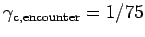 (m/#) governs how the
probability of finding a clam decreases as
(m/#) governs how the
probability of finding a clam decreases as
 c$[,]$
decreases. Using the third power means that unless the density of
clams is less than
c$[,]$
decreases. Using the third power means that unless the density of
clams is less than
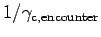 (#/m), crab's
will likely find clams.
(#/m), crab's
will likely find clams.
An individual crab feeds if a realization from a uniform random
variable,  , is less than the probability given by
Eqn (A.31). This is used to reflect the reality
that as clam density decreases, the probability of an individual crab
being successful in finding clams decreases. The purpose of this is
to afford clams a low density refuge while distributing found clams to
individual crabs. Thus, if a crab feeds the number of clams
consumed is just the expected value or the number of times it searched
multiplied by the probability of finding clams. This is rounded to
the largest integer value and is given by:
, is less than the probability given by
Eqn (A.31). This is used to reflect the reality
that as clam density decreases, the probability of an individual crab
being successful in finding clams decreases. The purpose of this is
to afford clams a low density refuge while distributing found clams to
individual crabs. Thus, if a crab feeds the number of clams
consumed is just the expected value or the number of times it searched
multiplied by the probability of finding clams. This is rounded to
the largest integer value and is given by:
# Clams Found Probability Finds Clams Probability Finds Clams # Searches # Searches |
(A.32) |
The number of clams found are selected from the clam age classes on
the triangle. The number of clams actually taken will either be the
number of clams to be found (Eqn A.32) or less than this
number if the mass of food feeding on is sufficient to fill
the crab's stomach.
Bigger clams are buried deeper in the sediments
than smaller clams. Thus, clams from each forageable age class,  ,
on the triangle are selected randomly using weighting factors which
account for the mass,
,
on the triangle are selected randomly using weighting factors which
account for the mass,
 ; number of clams,
  , in
that age class; and DO on the triangle. The weighting factor,
, in
that age class; and DO on the triangle. The weighting factor,
 , for forageable age class is given by
 |
(A.33) |
The weighting factors are constructed so that if the number of clams
is the same across all age classes, clams of smaller mass will have
larger values than larger clams. With
 which occurs when DO
  mg/L
(Eqn A.34), the larger the mass of the clam the
smaller will be its weighting factor and likelihood of being preyed
upon.
mg/L
(Eqn A.34), the larger the mass of the clam the
smaller will be its weighting factor and likelihood of being preyed
upon.
Short low oxygen durations that are not severe enough to produce
mortality can cause clams to extend their siphons farther to reach
higher oxygen concentrations (Tallqvist 2001; Taylor and Eggleston 2000) in
principle increasing the possibility of crab predation. This is
accounted for using:
 clam clam |
(A.34) |
where
clam, def is the default factor for a clam's
depth refuge. It should be noted that the actual effect of
clam was subsequently found to be rather small due to
crab avoidance of water with DO  mg/L, and thus the actual rate
of clam predation was no higher under hypoxic than normoxic
conditions, agreeing with empirical findings (Seitz et al. 2003a).
mg/L, and thus the actual rate
of clam predation was no higher under hypoxic than normoxic
conditions, agreeing with empirical findings (Seitz et al. 2003a).
If at the end of the above clam feeding algorithm a crab cannot find
sufficient clams to fill its stomach more than 50% full and if the
mass of food feeding on is less than 50% of the potential
grams of food it could feed on over the time interval if food were
widely abundant (Eqn A.38), the crab then attempts
to feed on background prey.
Probability finds background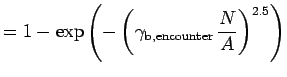 |
(A.35) |
where
 = 1/100 (m/#) governs how the
probability of finding background prey increases with the density of
background prey,
= 1/100 (m/#) governs how the
probability of finding background prey increases with the density of
background prey,  (Eqn A.25). If a
realization from a uniform random variable, , is less than the
probability it finds background prey, the crab feeds on the background
provided the number of grams of background to be consumed is actually
present on the triangle.
(Eqn A.25). If a
realization from a uniform random variable, , is less than the
probability it finds background prey, the crab feeds on the background
provided the number of grams of background to be consumed is actually
present on the triangle.
The mass of background prey a crab finds is exactly the difference
between the mass required to fill its stomach 50% full and the
mass of food feeding on found in the previous part of the
feeding algorithm. Thus, if a crab is forced to feed on background
prey, its stomach will never be more than 50% full.
Next: Energy Balance: Ingestion
Previous: Crab Energy Balance: Overview