Appendix E. Results of logistic regressions on fruiting or not (also summarized as percent of fruiting plants) using plant cohort, fire treatment, and block as predictors.
Fruiting or not year one post fire. None of the predictors nor their interactions were significant except that plant cohort was marginally significant in predicting fruiting or not the first year post fire (Wald = 3.365, df = 1, P = 0.067). The fire treatment effect in this analysis is similar to the analysis that did not include plant cohort as a predictor (Not significant; Appendix B Table B1). Block effects between the two analyses were not comparable because they included different blocks.
Fruiting or not year two post fire. Plant cohort (Wald = 14.10, df = 1, P < 0.001), fire treatment (Wald = 7.56, df = 2, P = 0.023), and block (Wald = 6.41, df = 1, P = 0.011) were significant. The three-way interaction was weak, but nonetheless significant (Wald = 6.89, df = 2, P = 0.032). The significant block and fire treatment effects are consistent with analyses that did not include plant cohort as a predictor (Appendix B Table B1).
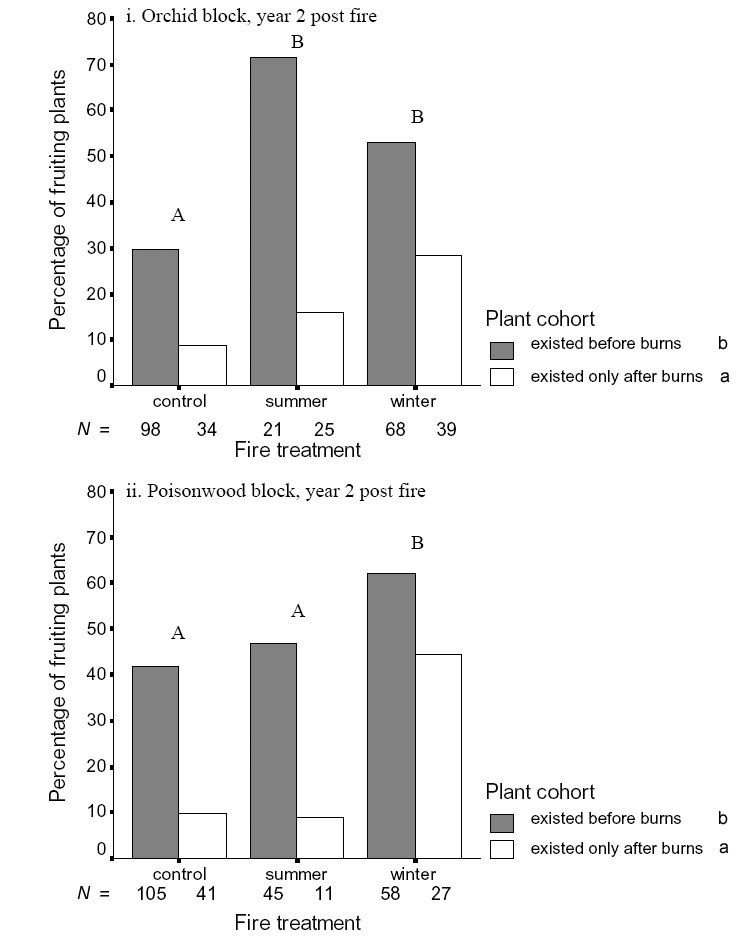
In both Orchid and Poisonwood block, plant cohort (Wald = 21.56, df = 1, P < 0.001; and Wald = 18.23, df = 1, P <0.001, respectively), and fire treatment (Wald = 17.27, df = 2, P < 0.001; Wald = 14.38, df = 2, P = 0.001, respectively) were significant predictors for fruiting or not during the second year post fire (Fig. E1). Specifically, plants that existed before burns had a higher percentage of fruiting plant than plants that appeared only after burns in both blocks. However, the two blocks differed in fire treatment effects. In Orchid block, both summer-burn (Wald = 10.26, df = 1, P = 0.001) and winter-burn treatments (Wald = 14.02, df = 1, P < 0.001) had significantly higher percentages of fruiting plants than the control treatment (Fig. E1i). In the Poisonwood block, however, the winter-burn treatment had a significantly higher percentage of fruiting plants than the control (Wald = 13.92, df = 1, P < 0.001) and summer-burn treatments (Wald = 6.20, df = 1, P = 0.013; Fig. E1ii).
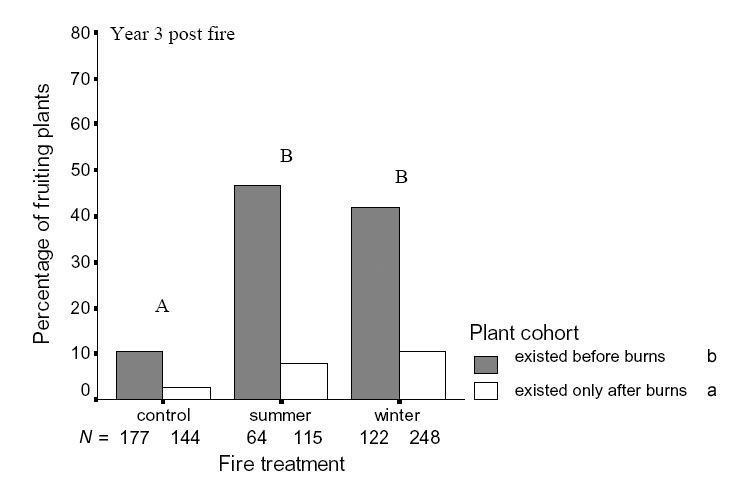
Fruiting or not year three post fire. Plant cohort (Wald = 78.41, df = 1, P < 0.001) and fire season (Wald = 47.384, df = 2, P < 0.001) were significant predictors (Fig. E2). None of the two-way or three-way interactions was significant. Plants that existed before fires had a significantly higher percentage of fruiting plants than plants that existed only after fires ((Fig. E2). Both summer-burn (Wald = 34.66, df = 1, P < 0.001) and winter-burn treatments (Wald = 42.75, df = 1, P = 0.001) had significantly higher percentages of fruiting plants than the control treatment. These results and those that did not include plant cohort as a predictor ( Appendix B Table B1) are similar.